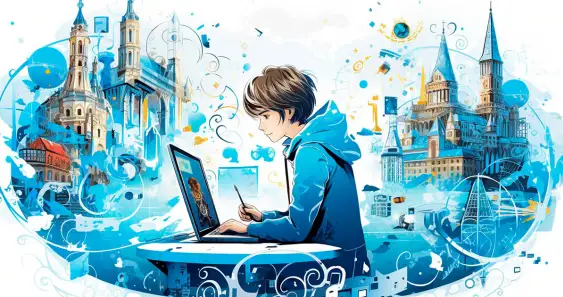
Did you know there is a faraway city called Textopolis, where reality intertwines with the world of words? Its streets shimmer with coloured letters, its houses are decorated with inspiring phrases, and its people live in harmony with the magic of literature.
In this city lived a young man named Peter. He had an unusual gift. Peter could spin astonishing webs from words, webs that opened whole worlds and told their captivating stories.
From childhood, Peter was immersed in the world of text. Instead of playing outside, he spent hours among the pages of books. Each book was a gateway to the unknown, and each new word was like a palette for his imagination. Over time, the boy began to create his own stories.
One day, while walking through the park, Peter saw a magnificent web carefully woven by Lena Spinner. It was something magical: many fine threads joined in a pattern, creating the impression of an invisible mist. And the boy had an idea: to create a web not from threads, but from words.
The idea struck him like lightning. Peter imagined how wonderful it would be to use, in place of ordinary illustrations, a web that would carry readers straight into the world of fairy tales. He began to think about how to give people the chance to see, feel, and immerse themselves in a book.
The young man studied the art of weaving and learned how to choose words so that they would join into a picture and tell an engaging story. The first attempts were difficult, but with each new web, Peter grew more and more skilled.
At first, he created small stories inspired by everyday life in Textopolis. He wove words about friendship, adventures, and dreams, making his webs so lifelike that they seemed to create a second reality.
Word of the unusual craftsman spread throughout Textopolis. People came to see his creations. They felt how each word transported them to another world, as if they themselves had become part of the story.
The maestro never expected popularity or fame, but he was happy to see his idea bring joy to others. He spoke about his work at meetings, shared his knowledge and techniques with those who also wanted to learn how to create wondrous word-webs.
But, as often happens, success brought shadows of envy. Some residents of Textopolis began to doubt that Peter's webs could really be considered art. They said that weaving words could not compare with the classical forms of art.
Peter felt the pressure of criticism, but he did not give up. He was convinced that his webs carried something more than a mere collection of words. He resolved to prove to everyone that art can take many forms.
The young master set out to create the largest and most intricate web in the history of Textopolis. He began to weave a vast structure of thousands of words and phrases that interacted with one another, creating incredible visual effects. This web became a magnificent work of art, in which every word had its place and meaning.
When he finished, he decided to present his creation at an art exhibition. It was the most important moment of his life. He knew that important people would be at the gallery and could appreciate his masterpiece.
At the opening, Peter was aglow with his idea. Into every word, every phrase, and every knot, he had poured a piece of his soul: his ideas and dreams. He watched as people studied the web with interest, admiration, and surprise.
Suddenly, something amazing happened. Before the guests' eyes, the web began to come alive. It began to bloom! The words and phrases started to shimmer with colour, creating a three-dimensional visual show. Pure magic!
Everyone was stunned by the incredible spectacle. Peter's web transported the viewers into a fairy tale. A true miracle!
Everyone who had once doubted the young man's art now recognized his talent. They understood that art can be diverse and astonishing.
Peter became a true hero of Textopolis, and his webs became a symbol of creativity, courage, and believing in oneself.
He continued to create masterpieces, making the world brighter and more colourful. His works were recognized as unique and valuable, and his art continued to delight and inspire the city's residents.
And so was born the legendary Spider-Man of Textopolis, who proved through his creativity that every word can become part of the magic, capable of carrying us into a world of wonderful stories and unforgettable adventures.