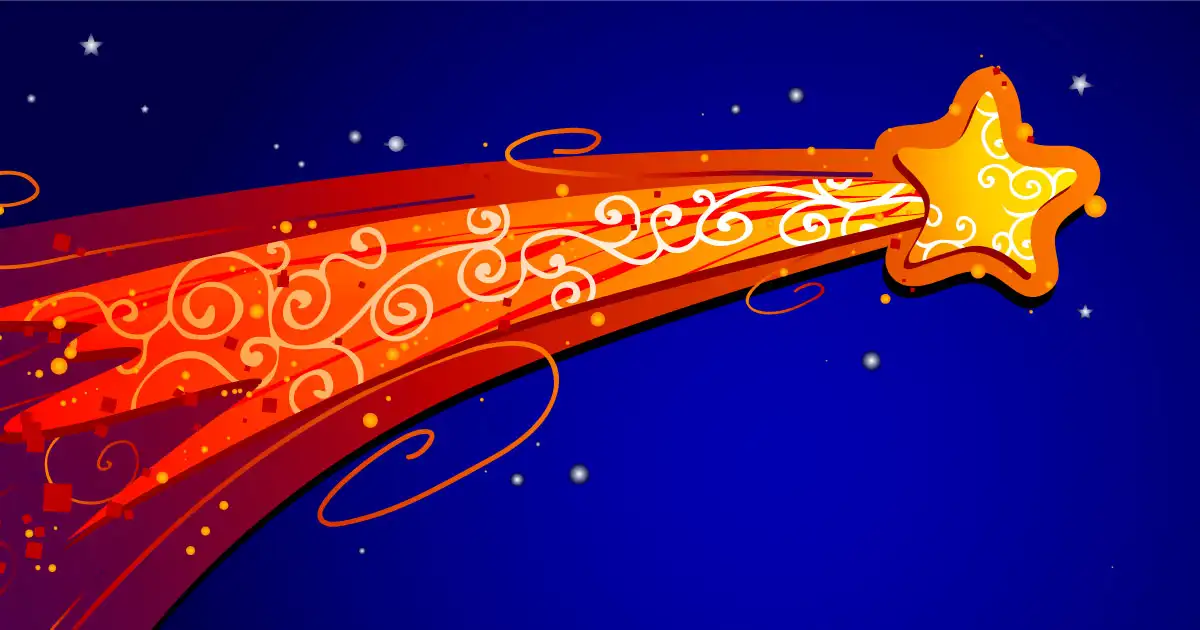


Far, far away in space there once lived a little star. Of course, she was only small compared to some of the other stars—to you and me she would have seemed enormous.
She was bigger than trees, and houses, and even our Sun. Well, but that's not the point. More than anything in the world, the little Star loved to look at other stars and wonder how they lived, what they saw around them, what they dreamed about. But she didn't know how to ask them about it, so she felt very lonely.
Of course, several planets orbited around her, and she had tried to strike up conversations with them before. But the conversations never went anywhere: the planets weren't interested in things far away from them. Usually all their talk ended in arguments about who should orbit whom and whose trajectory (that is, path around the star) was more correct and beautiful. But the little Star got tired of it, and stopped bothering the planets with conversations about things that didn't interest them in the slightest.
But one night (or perhaps it was day—it's hard to say, since it's always night in space) a comet flew past the star. She was very surprised, because she had never seen anything like it before.
Hello! My name is Star, and who are you?
She greeted the stranger.
I'm a comet. Haven't you ever seen comets before?
Her new acquaintance answered with surprise in her voice.
No. I only see the planets that orbit around me.
The little Star answered sadly.
That's very strange. There are so many of us flying all over space! But apparently it's so vast that we don't even reach its far corners… Comets are celestial travellers. We're a bit like planets, only much smaller and lighter, so we don't orbit around one star—we fly wherever we want! I'm an icy comet, but there are also comets made of stone and metal.
Said the comet.
How fascinating! I'm so envious of you—you've seen so much! Tell me, are you in a great hurry? Could you stay with me for a while and tell me about the wonders you've managed to see?
Asked the little Star.
The comet wasn't in any hurry and accepted the little Star's invitation. She began to orbit around her along with the planets and told her amazing stories every day. The little Star learned that, as it turned out, all stars are different: some are very young (like her), and some are old, almost as old as the Universe itself.
Some are very hot, some are almost cooled down; some are small, and some are simply gigantic—so large that it takes a comet several years to fly along one of them. And most importantly—many of the stars that our little Star loves to watch have actually gone out long ago, they no longer exist! It's just that they're so far away that the last light they gave off before they went out has only just reached her now…
These stories enchanted and captivated the little Star. And one day she decided to ask the comet:
Tell me, do other stars communicate with each other somehow? I would so like to talk to them…
Yes, of course. If you look carefully at the sky, you'll see that the stars don't shine evenly—they constantly twinkle. Sometimes they flare up brighter, sometimes they almost go out… That's the language of the stars—that's how they communicate with each other.
The comet answered calmly.
Comet, how can I learn this language?
Asked the little Star excitedly.
Well, unfortunately I don't know it. It's a special language that only stars speak, and there are no textbooks for it. I think you need to watch them carefully and try to understand what they're blinking about… In about 200 years you'll have learned it all!
The comet hesitated.
The little Star felt a bit sad. But she didn't have much choice—either listen to the comet or go back to languishing in sorrow and loneliness. Soon her new friend flew away, and the little Star began to gaze intently at the dark sky with redoubled attention.
Years passed—but for the little Star they were like days for us—she watched the other stars and tried to decipher their mysterious language. And one night (or perhaps it was day, who knows) she was admiring a bright red star. And suddenly she saw it begin to twinkle. Three short, weak flashes, one bright one… And suddenly another star, a small, silvery-white one, also began to twinkle.
Three short flashes, one long and bright flash… 'Hello to you too,' thought the little Star to herself. And suddenly she understood: that really was a greeting! Yes, that's how they said hello, and she needed to twinkle back at them so they would know she had heard them! Apparently, the years she had spent looking at the dark sky had not been wasted.
She flashed three short flashes, one long one… That's it, now just to wait. The little Star knew the answer wouldn't come straight away; moreover, it might not come from any of these stars if one of them had already gone out. But the little Star was confident that within a hundred years or a thousand, from one star or another, she would get an answer. And these years of waiting would no longer be as painful as before.