


Chapter Four: How the Donkey Flew to Paris
One day chaos settled over the house. For a whole week everyone walked about discussing things and argued endlessly.
The donkey didn’t quite understand what was going on. He only really remembered German words and phrases, because as a child, sitting in a shop, he had heard plenty of German from customers in the faraway city of Frankfurt am Main. But even those he had begun to forget. And English he never seemed to learn.
He tried to eavesdrop to find out what all the fuss was about, but he never understood a thing. Then one morning his best friend, the flower Pipito, was taken away. They placed him in a bag together with his flowerpot and carried him off. Pipito left quietly, as he always did. But the donkey began to worry.
Then they started packing the donkey’s familiar things into a large suitcase. A fluffy jumper from the chair, and shiny little jars from the chest of drawers. The room gradually began to empty. Yet the donkey was never put in the suitcase. The donkey became very anxious.
‘They’ll all leave and forget me here,’ he thought, and his plush heart sank, and his ears drooped miserably.
But one day he was woken very early. Still half asleep, the donkey didn’t understand what was happening. He was simply pushed into a narrow gap in the suitcase... and how he fitted in at all was a mystery. The suitcase was zipped up tightly.
‘Well, that’s that, I won’t see a thing. They’re taking me too. I do hope it’s to Pipito.’
The donkey was carried along in the darkness for a long time. Then the zip was opened a little. He poked out his head and gasped: a huge aeroplane stood right in front of his nose. The donkey had flown in these before, and it was always exciting. And every time, the aeroplane carried him to a place even better than the one he had come from.
From that day on, the donkey loved to travel.
Chapter Five: How the Donkey Went for a Walk in Paris
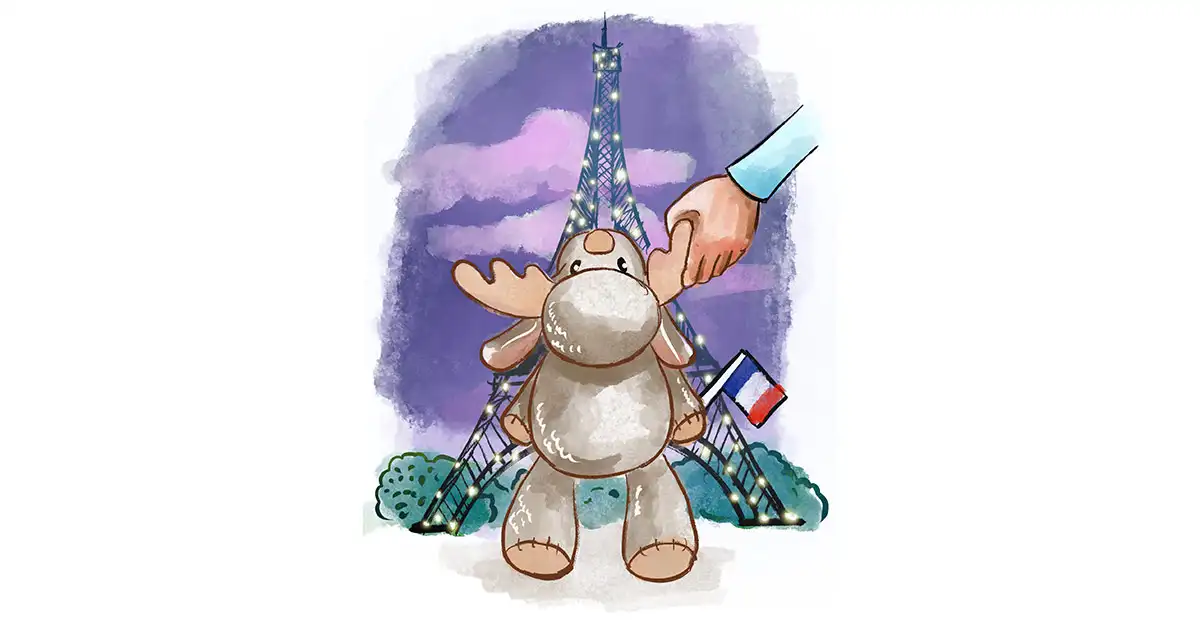
Paris smells of croissants, freedom and blossoming trees. Not everyone manages to fly to Paris, but the donkey did visit. One spring he set off for France with his family: the lady and gentleman of the house.
Each morning they woke up in a tiny room in a guesthouse. It was so small that the gentleman and lady could barely squeeze past each other on their way to the bathroom for a wash. But people do love a bath!
They weren’t upset by the size of the room, though. They just laughed and repeated: ‘Proper Paris!’
Meanwhile the donkey was still snuggled up in the white bedsheets, and then they all walked to a café for breakfast on fresh croissants. There is no tastier pastry than a fresh, crisp croissant made with butter.
The donkey poked his nose out of the lady’s large handbag and sniffed the fragrant air while the gentleman queued with the other customers. Sometimes they stayed for breakfast in the café, and on other days they headed to the squares, which in Paris are beyond counting. They settled by a little fountain or on a bench beneath the spreading branches of the trees.
The morning was the donkey’s favourite time. He could watch endlessly as people hurried to work on their bicycles, and as tourists strolled lazily, early risers just like themselves, afraid of missing even a minute of their trip, and as students who had been out late returned home only towards dawn.
On this trip the donkey realised that not every activity has to be useful. Sometimes you can simply enjoy the aroma of coffee with a croissant in the morning, a stroll along old cobbled streets and through shady parks in the afternoon, and the enchanting sight of the sparkling Eiffel Tower late in the evening.
Just to breathe, just to live.
And the donkey could feel that the family was perfectly happy. He could even hear the lady’s heart beating, because every so often, overcome with delight, she pressed him to her chest, saying: ‘Oh, how lovely! Magical!’
And the donkey himself felt something warm in his chest. It spread right through his body to the tips of his paws and even made his nose tingle a little. That was how the donkey understood what happiness is.
Chapter Six: How Winter Arrived
The donkey had been living with his new family for a long time, and each morning the lady of the house carried him over to Pipito on the windowsill.
The donkey loved spending time with Pipito. They sat all day, gazing out of the window at passers-by, at the clouds, at passing cars and at dogs and cats scurrying by. It was more interesting to watch them than the people.
And all day the friends silently talked about everything under the sun and waited for the lady of the house.
But one morning, settling on the windowsill, the donkey could not believe his eyes. Outside everything was white, white all over. And from the sky fell strange white flakes.
When people came in through the front door, they brought the cold and this white wonder on their shoulders and scarves, shook it off their boots onto the floor, and within a second it had turned into a puddle.
And now everyone had started wearing hats and scarves. The donkey had a scarf of his own, which he wore all year round. His throat was what he caught cold in most often. But he had no hat. And the donkey so wanted to taste this white wonder.
One day the lady washed her woollen hat in the washing machine. It shrank, so she gave it to the donkey. They pulled it onto his floppy-eared head, tucked his scarf in and took him out with them into the street.
The donkey trudged through the snowdrifts, sat in the hood of the lady’s coat, and breathed in the fresh frosty air. He even tasted the snow. But he didn’t like the taste of snow at all.
‘It’s a bit like ice cream...’ thought the donkey, ‘only ice cream is sweet and smells of vanilla. But to look at, the snow is very pretty. Just like ice cream.’
And the donkey drew a new conclusion: ‘Not everything that looks lovely from the outside is as good as it seems, once you’ve tasted it properly.’ That was how the donkey got to know real winter.