

Listen, little foxes, to the tale of Grandad's coat:
‘Once upon a time, in a cosy burrow near the bush, beside a billabong and a waterfall, there lived a young fox called Tully. He lived with Mum and Dad, and from Grandad he had inherited a magnificent coat, bright, warm and fluffy. With black paws and ears, a white belly and a white tip on the tail. Everything else was fiery ginger.
He took great care of that coat, tried not to tear it, and washed it often whenever he stepped in the mud.
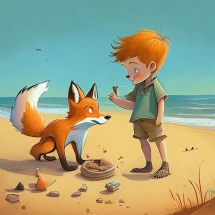
And then one day, while he was drying it on a branch and splashing about in the billabong, a not very nice boy wandered past. When Tully climbed out of the water, he saw the branch was empty, and the thief's tracks had long gone cold.
Tully was upset, and he was embarrassed to be seen in his bare state, with pink skin and a thin tail like a rat's.
Crying, he ran home to his parents. Of course, Mum told him she loved him just as he was. But, as you can imagine, that isn't much comfort.
Dad, however, gave some sensible advice: go to the mountains, where Grandad now lives, and ask whether he has one more coat left.
Tully set off early in the morning so nobody would see him. First, a swamp blocked his way. It smelt of rot, and even the mighty gum trees there grew as thin as sticks. He had to walk very carefully along the log path and hop from lily pad to lily pad to avoid sinking into the bog.
More than once he slipped in and had to scramble out again. Sometimes he had to turn back when the path ended in a dead end.
He had to sit down and think hard about how to get out of the maze. But eventually, by evening, he stepped onto solid ground.
Tully began shaking the mud off his paws and noticed that where his paws had sunk into the muck, the fur had turned black. His ears had gone black too, because he had been scratching them thoughtfully with muddy paws.
Walking along the abandoned track, the young fox was caught by nightfall and decided to spend the night in the old human cemetery. There it was, just ahead. There were tombs, sad statues and leaning crosses. But it smelt of nothing at all, neither living nor dead.
As soon as midnight came, a bell rang on its own and ghosts rose from their graves. They gathered round the fox, who had settled on a slab of white marble, and began telling him their spooky stories. Although Tully had learnt human language, he could not understand theirs, and nobody on Earth knew it any more apart from a handful of scholars.
So as not to offend the ghosts, he listened carefully, nodded, and even let the spirit of a little girl touch his tail. He knew that spirits are harmless, especially human ones, and he was not afraid of them. Even so, when he woke, damp with morning dew, he found white fur on his belly and on the tip of his tail. Perhaps it had grown from the cold of the marble slab.
Tully continued his journey along the road, which wound like a switchback up the mountain. At first he bounded briskly across the bends, but then for some reason the air grew thin, and he had to walk along the wheel ruts, slowly and with frequent stops.
He drank water from mountain streams, and the bush around him gave way to meadows with fragrant flowers and chirping grasshoppers. Then the meadows dropped away too, and snow-capped mountains rose ahead. The setting sun appeared over the pass and lit up Tully with its red rays.
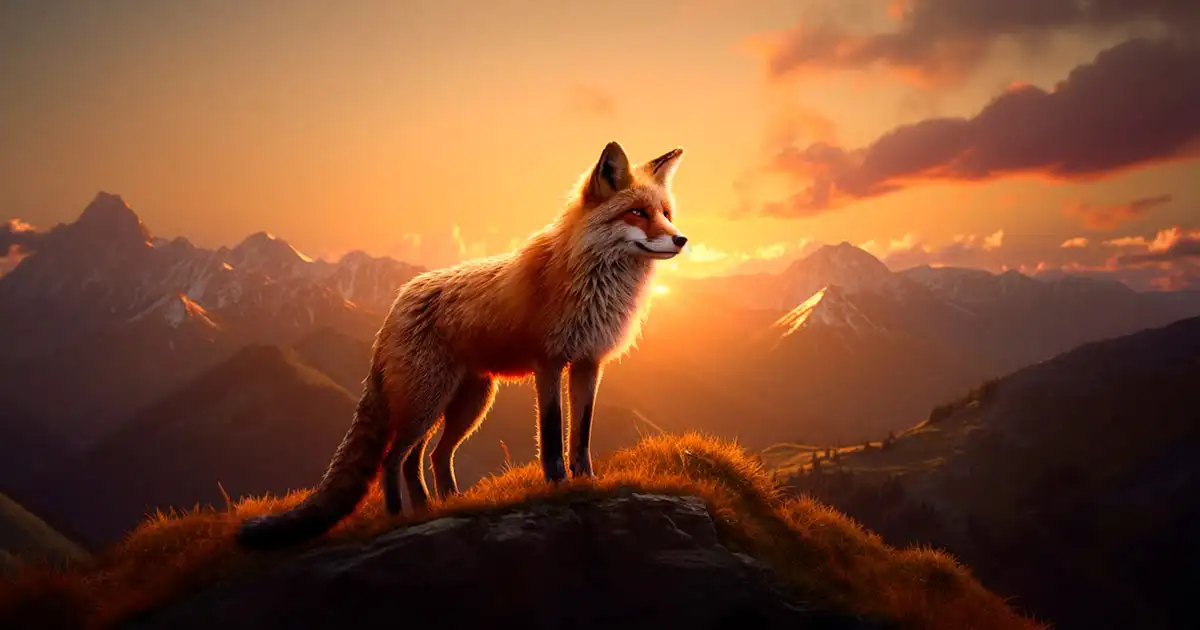
He felt the warmth and looked down at himself. To his surprise, his whole body was covered again in ginger fur, this time his own. He looked into a frozen puddle and saw in its reflection a magnificent fox, even fluffier than before, with black paws, ears and a splendid tail with a white tip. Besides, the old coat had been too big, while this one fitted just right. In principle, he could have turned back. But Grandad was only a short way off, so Tully decided to visit him.
Grandad lived in a spacious cave decorated with sparkling stalactites. With age he had turned quite white, and the air down below no longer agreed with him. He welcomed Tully and said he was not upset that Tully had lost his old coat, and there was no need to worry about it. He was simply glad that Tully had managed to get a new one.
Grandad offered him a place to sleep in the cave, and in the morning gave him some advice: ‘You have passed three trials, but three is only found in human fairy tales. Foxes have four. The fourth awaits you, and to pass it, remember who you really are.’
In the morning Tully started down the mountain. It went much faster, since he already knew the way and was happy after his meeting with Grandad and his new coat. He nearly tumbled down the switchbacks, hopped across the bog, and was already running towards his home burrow when suddenly he met the Trader.
The Trader was wrapped head to toe in a black cloak, and it was impossible to tell what he looked like. ‘Poor little creature,’ said the Trader, ‘you have lost something important, but you don't know what it is.’
Tully was puzzled: everything seemed to be in place. Four legs, a body, a tail, a black nose, ears. He looked himself over carefully and felt around his body.
‘I'll give you THIS for free, and you'll find THEM in my sack,’ the stranger went on.
Tully was just about to climb into the Trader's sack when he suddenly remembered something: he could not feel the opening of the sack, the way he always could when going into a burrow. Whiskers ― that was exactly what he was missing!
The fox jumped back just as the Trader was about to catch him, and bolted into the scrub. From a safe distance he watched the stranger angrily fling the sack to the ground and vanish into thin air. And Tully felt long whiskers sprouting from his nose, his brows and his shoulders, the kind foxes use to sense obstacles in total darkness and to tell truth from lies.
Now his trials were over, and he went home. The End.’
What happened to that boy? asked the first young fox.
The one who stole Grandad's coat? He put it on and ran off to the city. There people mistook him for a fox and sent him to the zoo, where he still sits to this day. He keeps insisting that he is a boy and that the coat isn't his. But foxes never get believed by people.
And who is the Trader? asked the second.
No idea. He looks like a person, but he smells of nothing at all. His whole body is covered in black clothing, and what is underneath is anyone's guess. If you ever see him, whatever you do, don't agree to any of his offers.
Why don't people have their own coats? yawned the third.
They used to. But then they lost them, though that's a whole other story.
I wish my coat could come off, said the fourth. Then I could pretend to be a boy and eat as many ice blocks as I liked.
Ice blocks are bad for little foxes. Now get to sleep.