




This happened a very long time ago. One ancient book says it was in 542 BCE, another says it happened 2500 years ago.
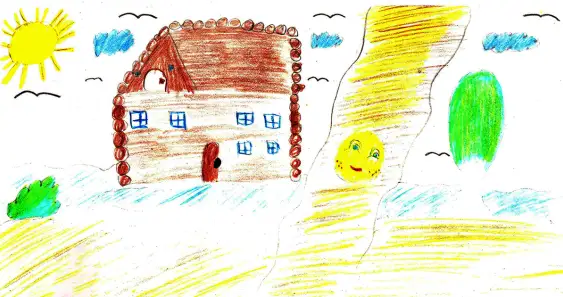
At the very foot of the Himalayan mountains, in India, there was a small kingdom. The King and Queen were very kind people, but they had no children. Year after year passed. Then one day, the Queen had a dream that a white baby elephant flew to her and touched her with its trunk.
She wasn't frightened, but woke with hope that this was a good sign. And indeed, after some time, she gave birth to a child. It was a boy. He grew not by the day, but by the hour. He began walking and talking almost immediately. And his gaze was so intelligent and aware, like that of a very wise person.
Where he stepped, lotus flowers grew. Where he passed, everyone became wiser, and wherever he went — he brought goodness everywhere.
The boy said:
I was born to gain knowledge and free all living things from suffering.
His father surrounded the little prince with care and attention. He taught him to ride horses, shoot arrows, as well as various games and entertainments. The boy never left the kingdom walls, as his father built him four palaces for all the seasons: winter, spring, summer and autumn. He arranged it so that only young and healthy people lived in the city, so the boy wouldn't see old age and illness. His father decided that his son would be king when he grew up.
One day, whilst walking through the kingdom, the heir wandered into a distant street and heard a song there in a strange foreign language. The young prince asked his mate to translate its content. And he revealed that there were other countries, another life. Not as good and carefree as his, but rather poor, with diseases, suffering and poverty.
I must see the world.
He said.
And, returning to his chambers, he gathered the most necessary things and went to see what was happening in the world.
The first thing the young prince saw, leaving the kingdom gates, was that life was filled not only with joy and laughter, but also with suffering. And he decided that he would teach and learn how to free oneself from suffering. Looking around and observing the lives and concerns of other people, he understood that the world that had surrounded him since childhood and to which he was so accustomed, was actually not like that everywhere.
Sometimes it seems that everything is good and wonderful, but this is only an illusion. And to understand what the truth is, one needs to develop spiritually and become enlightened. Only an extraordinary person can do and think this way, and that person is Buddha.
He would sit at the foot of Mount Kailash, 6638 metres high, and dream. And at that time, an unusual glow of red, blue and white appeared over the mountain. It illuminated everything around, the emanating light was so bright that it hurt to look at it.
One day a bear came to Buddha and asked:
How can I quickly dig a large den?
Budda advised him to start by digging a small hole first, then a bigger hole, and that's normal. After all, you must always start with small things. This was the first lesson.
The second followed. A little owlet had a sore wing, and because of this he couldn't fly. And Buddha advised him to think that his wing was healthy, strong and didn't hurt at all. The owlet thought about it so often that everything really did stop hurting, and he flew.
And the essence of the second lesson is that thoughts are material. What you think about happens in reality (comes true).
Once black crows couldn't share their prey amongst themselves and were angry at each other because of it. They even fought, because one of them got a bigger piece than the other. Buddha suggested the offended crow forgive the offender, and the conflict was resolved. Thus appeared the third lesson.
And once, whilst swimming in a pond, a little duckling caught his foot on a snag and couldn't free himself. And his mate was swimming carelessly nearby and did nothing to help. This was seen by a goose, who was also swimming in this pond, and he quickly came to help. So here's the thing: actions matter: you must act, not be inactive. This was Buddha's fourth lesson.
As in the animal world, so in the human world, you must try to understand another person first, and then talk about yourself and your desires. Such was Buddha's fifth lesson.
And here's another: a young bloke came to Buddha for advice. He couldn't understand what he wanted himself. His thoughts ran one ahead of the other, and, accordingly, the young bloke would start one task, then abandon it without finishing, and take on another that seemed more interesting to him, then interrupt and start a third task... In the end, he never finished anything.
The young bloke was very scattered, unfocused and Buddha gave him a lesson, which he called the sixth. The essence of the lesson is as follows: "Conquer yourself, learn to control your thoughts, be consistent in bringing them to life". This lesson is considered one of Buddha's most important lessons, only clever, brave and disciplined students are capable of completing it.
With his seventh lesson Buddha teaches living in harmony. Never dwell on troubles. Don't live with grievances. Don't harbour malice. Don't get irritated. Be able to quickly forget the bad.
And his eighth lesson is very useful: "Be grateful". There will always be something to thank mates for, acquaintances and strangers, teachers, Higher Powers.
That's Buddha and his lessons. And he also strongly believes that there is another world, where final liberation and peace occurs, where there is no suffering, and it's called — nirvana.
And our life — is a cycle. All things are impermanent by their nature. Everything flows and changes under the influence of the environment, events that have occurred. Therefore, one must learn, read a lot, to understand the world and the laws of nature, be flexible and ready for any changes.